8 Artificial Intelligence in XR Technologies
8.1 Introduction to AI in Immersive Media
Artificial Intelligence (AI) is increasingly becoming an integral part of Extended Reality (XR) technologies, enhancing the capabilities and user experiences of virtual, augmented, and mixed reality applications. This chapter explores the intersection of AI and XR, highlighting how machine learning and intelligent systems are shaping the future of immersive technologies.
Key areas where AI is making an impact in XR include:
- Computer vision for improved tracking and environment mapping
- Natural language processing for more intuitive voice interactions
- Machine learning for adaptive and personalized experiences
- AI-driven physics simulations for more realistic virtual environments
As we venture further into the digital age, the convergence of artificial intelligence, the metaverse, and immersive technologies is becoming increasingly significant. This convergence is reshaping how we interact with digital content and environments, offering new possibilities for human-computer interaction and digital world creation.
This natural and human interface that VR and AR makes possible creates digital worlds where it’s easier to populate environments with artificial intelligence and create smarter, more responsive spaces.
This shift towards more intuitive, immersive interfaces presents an alternative to the increasing presence of robots in our physical spaces. Instead, it allows humans to interact more naturally with digital content and AI-driven entities within virtual environments.
8.2 AI-Generated Environments and Objects
One of the most exciting developments in this field is the use of AI to generate and populate virtual environments. This addresses a significant challenge in VR development.
These AI tools provide us with more advanced capabilities to create rich and interesting virtual worlds—addressing what has been holding back VR applications, namely the significant effort required to develop compelling virtual environments.
8.2.1 AI-Generated 360° Worlds
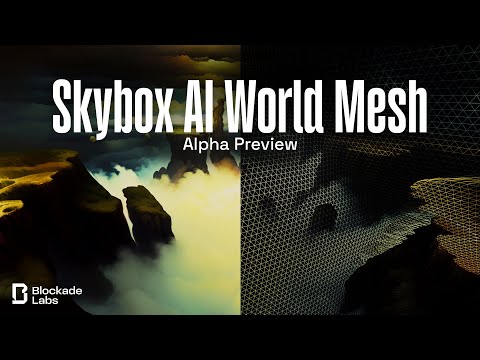
AI is now capable of generating entire 360° environments that users can explore in virtual reality.These AI-created worlds go beyond static images, incorporating depth information to create fully navigable 3D spaces.
8.2.2 Roblox’s AI Integration
Roblox, a popular platform for creating and sharing virtual experiences, is at the forefront of integrating AI into world-building tools. Their “Chat to Create” feature allows users to verbally describe objects and environments they want to create.
You can essentially converse with these AIs and describe what you want: “I want a fireplace here, a bear there, and I want it to be in armor.” The AI generates these elements, allowing you to build out virtual environments through conversation—environments you can then invite others to experience and share.
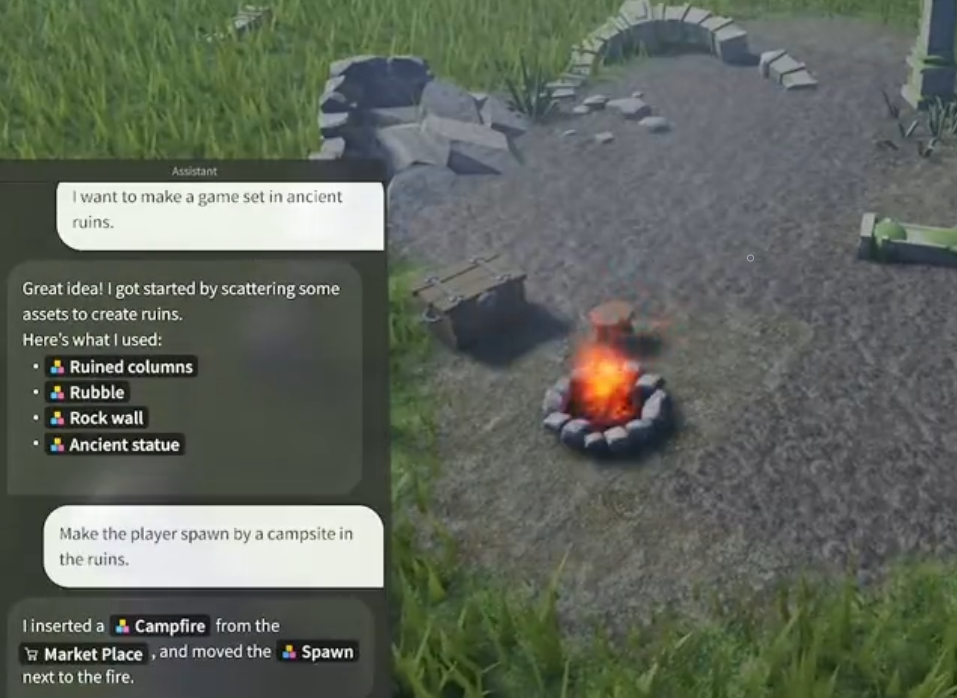
This technology democratizes the creation of virtual worlds, allowing users with no programming or 3D modeling experience to bring their imaginations to life through simple conversation with an AI.
8.2.3 AI-Generated 3D Objects
The capabilities of AI in 3D content creation extend to individual objects as well. Tools like DreamCraft3D allow users to generate detailed 3D models simply by providing a text description.
By simply writing a text description of what you want, you can generate a fully 3D virtual object that can populate your virtual environments or be placed in real environments through augmented reality.
This technology has wide-ranging applications, from populating virtual worlds with unique objects to creating AR experiences where AI-generated models can be placed in the real world through a device’s camera.

8.2.4 Implications for XR Development
The integration of AI-generated content in XR environments has several significant implications:
- Rapid Prototyping: Developers can quickly generate and iterate on virtual environments and objects.
- Personalization: AI can create custom environments and objects based on user preferences or specific requirements.
- Scalability: The ability to generate content algorithmically allows for the creation of vast, diverse virtual worlds.
- Accessibility: Non-technical users can participate in content creation, potentially leading to more diverse and creative XR experiences.
As AI technologies continue to advance, we can expect even more sophisticated and seamless integration of AI-generated content in XR applications, further blurring the lines between human-created and AI-generated virtual worlds.
8.3 Generative 3D Pipelines and Interactive Worlds
The past year has produced a clearer pipeline for moving from prompts to explorable spatial experiences. Successful teams treat generative systems as modular stages that can be swapped or repeated depending on the fidelity targets.
8.3.1 Pipeline Overview (2025)
- Prompting & Concept Capture: Start with text, sketches, or reference images. Platforms such as World Labs’ Marble accept plain-language prompts and return explorable 3DGS scenes.(World Labs 2024)
- Intermediate Video or Scene Generation: Systems like Odyssey’s interactive video demos and DreamInteractive’s UE5 workflows generate cinematic flythroughs or layout videos that double as validation passes.(Odyssey Studios 2024; DreamInteractive 2024)
- 3D Asset Materialization: Choose output modalities—Gaussian splats, meshes, or hybrid representations. Genie 3 and TRELLIS-style research models offer toggles between splats and meshes; DreamInteractive demonstrates mesh handoffs to Unreal Engine.(Qian et al. 2024; DreamInteractive 2024)
- Engine Import & Interaction Layer: Bring assets into Unity or Unreal, add lighting, physics, and interactions, and connect to multiplayer or analytics services.
- Deployment & Iteration: Test the experience on target hardware, gather telemetry, and feed findings back into the prompt or editing stages.(World Labs 2024; Decart AI 2024)
- Temporal coherence: Video-first outputs (e.g., Odyssey) still struggle with shot-to-shot continuity; expect to curate sequences manually.(Odyssey Studios 2024)
- Physics and affordances: Generated worlds rarely include collision volumes or gameplay logic—teams must author these layers post-import.
- Texture fidelity & scale: Mesh exports can arrive with stretched UVs or inconsistent scale; always validate measurements before interactive deployment.
- Cost envelopes: Cloud-based systems (Marble, Decart-XR) meter GPU time; budget for iteration passes when scoping projects.(World Labs 2024; Decart AI 2024)
8.3.2 Import Checklists
Whether the output is a splat or a mesh, keep a standing checklist before you promise interactivity:
- Coordinate alignment: Normalize scene scale and orientation so generated spaces align with engine units.
- Lighting strategy: Decide between baked lighting, real-time global illumination, or emissive splats; World Labs scenes often ship with lighting baked into textures.
- Interaction shells: Add invisible collision meshes or navmeshes for locomotion. DreamInteractive’s UE5 demos illustrate wrapping generated geometry with simplified colliders for traversal.
- Accessibility hooks: Pair AI-generated layouts with hand-authored UI, captions, and locomotion options before shipping.
8.3.3 Case Spotlights
- World Labs Marble: Prompt-to-3DGS restaurant scenes stream directly to browsers and Vision Pro, showcasing rapid ideation.(World Labs 2024)
- DreamInteractive UE5 Workflow: Uses generative passes to block out spaces, then layers Unreal assets for gameplay—ideal for hybrid AI/manual teams.(DreamInteractive 2024)
- Genie 3 Analyses: Research deep dives explain how structured latents unlock mesh or splat outputs from the same prompt, guiding pipeline decisions.(Qian et al. 2024)
- Decart-XR: Real-time passthrough transformation on Quest illustrates how AI-generated visual styles can be interactive, not just static captures.(Decart AI 2024)
8.4 AI-Driven Characters and Interactions
As AI technologies advance, they are revolutionizing the way we create and interact with virtual characters in XR environments. From intelligent non-player characters (NPCs) to virtual assistants, AI is enabling more natural, responsive, and engaging interactions in immersive experiences.
8.4.1 Virtual AI Agents
Virtual AI agents are becoming increasingly sophisticated, offering personalized interactions within virtual environments. A prime example of this technology is demonstrated in a golf game featuring an AI caddy named Arthur.
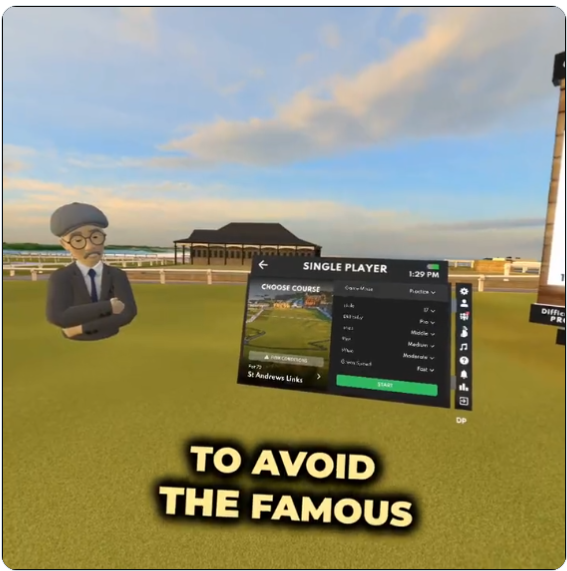
In this application, users can engage in natural language conversations with Arthur, who serves as both a caddy and coach. The AI agent utilizes advanced language understanding and generation capabilities to provide contextually relevant advice and information about the golf courses.
The virtual caddy introduces himself naturally: “Hello there. My name is Arthur, and I’ll be your personal caddy and coach. What would you like me to call you?”
This level of personalization and interactivity showcases the potential for AI agents to enhance user experiences in virtual environments. However, it’s worth noting that the widespread implementation of such sophisticated AI interactions may still be limited by computational costs.
However, I’m not certain if this technology is widely released yet. One limiting factor is that these AI systems are still rather expensive to operate, which may be holding back broader implementation in consumer applications.
8.4.2 Large Language Models in XR
The integration of large language models (LLMs) like GPT-3 and its successors into XR environments is opening up new possibilities for creating intelligent, context-aware virtual characters. These models can:
- Generate dynamic dialogue based on user interactions and the current context.
- Adapt character behavior to user preferences and past interactions.
- Provide real-time language translation and cultural context in virtual environments.
8.4.3 Emotional and Contextual Awareness
Advanced AI systems are being developed to recognize and respond to users’ emotional states and contextual cues within XR environments. This includes:
- Facial expression recognition to adapt character responses
- Voice tone analysis for more nuanced interactions
- Body language interpretation for more natural social interactions
These technologies have the potential to create more empathetic and responsive virtual characters, enhancing the overall immersion and engagement in XR experiences.
8.5 AI in Content Creation and Storytelling
AI is not only changing how we interact with virtual environments but also how we create content and tell stories within these spaces. From procedurally generated worlds to AI-assisted narrative design, the possibilities are expanding rapidly.
8.5.1 AI-Generated Movies and Immersive Narratives
The realm of content creation is being revolutionized by AI-generated movies and narratives. These productions are entirely produced by artificial intelligence, from script to visuals, showcasing the immense potential of AI in creative industries.

Several platforms and models are at the forefront of this technology:
- Pika: An AI-powered platform for creating and editing videos.
- Stable Video Diffusion: An open-source AI model for video generation and editing.
- Sora: OpenAI’s text-to-video model, capable of generating highly realistic video content from text descriptions.
These tools are pushing the boundaries of what’s possible in digital content creation, allowing for the rapid production of complex, high-quality video content without traditional filming and editing processes.
8.5.2 AI-Assisted World Building
The concept of AI-assisted world building is bridging the gap between imagination and reality in virtual environments. While not yet fully realized, the potential for AI to assist in creating complex, dynamic virtual worlds is immense.
AI-assisted world building could potentially allow creators to:
- Generate detailed environments from high-level descriptions
- Dynamically adjust and expand virtual worlds based on user interactions
- Create consistent and believable ecosystems within virtual spaces
This technology could dramatically reduce the time and resources required to create large-scale virtual environments, making it possible for smaller teams or even individual creators to build vast, immersive worlds.
8.5.3 Procedural Content Generation
AI-driven procedural content generation is already being used in many games and virtual environments to create diverse and seemingly endless content. This includes:
- Terrain generation for expansive virtual landscapes
- Dynamic NPC behavior and dialogue
- Adaptive music and sound effects that respond to user actions and environment
As AI technologies continue to advance, we can expect even more sophisticated procedural generation techniques that create not just individual elements, but entire coherent and richly detailed virtual worlds.
8.5.4 Implications for XR Storytelling
The integration of AI in content creation and storytelling for XR has several important implications:
- Personalized Narratives: AI could adapt stories and environments in real-time based on user preferences and actions.
- Infinite Content: AI-generated content could provide endless variations of experiences within a single XR application.
- Collaborative Creation: AI could serve as a creative partner, assisting human creators in developing more complex and nuanced virtual worlds and narratives.
- Accessibility: AI-assisted creation tools could make it easier for non-technical users to create sophisticated XR content.
As these AI technologies continue to evolve, they promise to unlock new possibilities for expression, learning, and experience across a wide range of XR applications, potentially transforming how we create and consume immersive content.
8.6 AI for XR Development and Optimization
Artificial Intelligence is not only enhancing the content and interactions within XR environments but also revolutionizing the development process itself. From optimizing performance to enhancing rendering techniques, AI is becoming an indispensable tool for XR developers.
8.6.1 Performance Optimization
AI algorithms are being employed to optimize the performance of XR applications in real-time. This includes:
Dynamic Level of Detail (LOD): AI can adjust the complexity of rendered objects based on their importance and the device’s performance capabilities.
Predictive Loading: AI algorithms can predict user movements and pre-load relevant content, reducing latency and improving immersion.
Adaptive Resolution Scaling: AI can dynamically adjust rendering resolution to maintain frame rates while maximizing visual quality.
These optimizations are crucial for maintaining the high frame rates and low latency required for comfortable XR experiences, especially on mobile devices or standalone headsets with limited processing power.
8.6.2 Machine Learning for Gesture and Voice Recognition
Advanced machine learning models are enhancing the way users interact with XR environments through gestures and voice commands.This section focuses on AI-driven improvements to recognition technologies, while foundational gesture and voice recognition principles, implementation techniques, and design best practices are covered in Section 5.8.
Gesture Recognition: AI models can recognize complex hand gestures and body movements, allowing for more natural and intuitive interactions in VR and AR.
Voice Commands: Natural Language Processing (NLP) models enable sophisticated voice control systems, allowing users to interact with virtual environments using natural speech.
Multimodal Interaction: AI can combine inputs from various sources (gesture, voice, eye-tracking) to interpret user intent more accurately.
These AI advancements are particularly important for creating accessible XR experiences and for scenarios where traditional input methods are impractical.
8.6.3 AI-in-the-Loop Workflows for Development
AI tools are now embedded throughout the XR production toolchain, helping teams ship faster while maintaining quality. Treat these assistants as collaborators that accelerate ideation, refactoring, and asset audits rather than full replacements for human expertise.
- Coding companions: Engine-native assistants like Epic Developer Assistant surface Unreal documentation, write Blueprint snippets, and answer API questions in context. Pair these tools with automated tests to validate generated code before merging.(Epic Games 2024)
- Rapid prototyping: Workflows such as Claude Code’s Three.js apartment build show how AI can scaffold entire webXR scenes from photo sets—useful for pitch decks or quick user tests.(Hernandez 2024)
- Search and refactor: Integrate chat-based code explorers to trace input pipelines or render loops across large projects; this shortens onboarding for new teammates.
- Asset provenance: Maintain a provenance log when importing AI-generated meshes or textures from tools like BlenderGPT and Meshy. Document prompts, sources, and licenses to ease compliance reviews.(BlenderGPT Team 2024; Meshy 2024)
- Continuous review: Schedule human-in-the-loop checkpoints to confirm that AI suggestions respect performance budgets, accessibility requirements, and platform guidelines.
Create a shared “AI usage register” for your team that tracks which assistants were used for code, art, or design decisions. This audit trail supports ethical sourcing discussions and helps debug regressions when a model update changes outputs.
8.6.4 AI-Enhanced Rendering Techniques
AI is also being used to improve the visual quality of XR experiences while maintaining performance:
Neural Rendering: Techniques like Neural Radiance Fields (NeRF) use AI to generate photorealistic 3D scenes from a set of 2D images.
AI Upscaling: Machine learning models can upscale lower-resolution renders to higher resolutions in real-time, reducing the computational load while maintaining visual quality.
Intelligent Occlusion: AI can predict and render realistic occlusions in AR applications, improving the integration of virtual objects into the real world.
Gaussian Splatting represents a particularly interesting development for creating photorealistic avatars that could become more readily available in XR applications.
While still in development, these AI-enhanced rendering techniques promise to significantly improve the visual fidelity and performance of XR applications.
8.6.5 Documenting AI Collaboration in Development
As AI tools become standard parts of XR development workflows, how you document their use becomes an important professional practice. This isn’t about confession or compliance—it’s about making your development process transparent, learnable, and reproducible.
What to Document: Process, Not Just Tools
Rather than simply listing AI tools used, document the development process and how AI collaboration shaped it:
- Initial challenge: What problem were you trying to solve or what feature were you implementing?
- AI interaction: What did you ask the AI? How did initial suggestions compare to what you needed?
- Critical evaluation: Where did AI suggestions work well? Where did you need to modify or reject them?
- Iterative refinement: How did the solution evolve through conversation with AI tools?
- Final implementation: How does your final code or design differ from initial AI outputs, and why?
This documentation demonstrates understanding and critical engagement, not just AI use.
XR Development Examples
Consider these concrete scenarios where documenting AI collaboration adds value:
Shader Development: You’re implementing a custom shader for volumetric fog in your VR environment. An AI assistant suggests an approach, but you notice it doesn’t account for stereo rendering. Your documentation might note: - Initial challenge: Performant volumetric fog for VR - AI suggestion: Standard single-pass volumetric approach - Your modification: Adapted for stereo rendering with single-pass instancing - Performance consideration: Reduced from AI’s suggested quality level to maintain 90fps
This documentation helps future developers (including yourself) understand both the AI contribution and the XR-specific expertise you applied.
Locomotion Mechanics: When implementing teleportation movement, AI tools might suggest standard approaches. Your documentation captures: - How you modified AI suggestions to prevent motion sickness - Why you rejected certain AI recommendations based on comfort testing - How you iterated on the arc visualization based on user feedback - Platform-specific adaptations AI didn’t initially consider
Interaction Pattern Design: For a hand-tracking interaction system, document: - Initial AI suggestions for gesture recognition thresholds - How play-testing revealed different needs for your specific use case - Adjustments made for accessibility (larger tolerance ranges, alternative inputs) - Integration challenges AI didn’t anticipate when working with your specific SDK
Practical Implementation
You don’t need elaborate systems. Effective documentation can be:
Project notes: Maintain a development journal noting significant AI interactions
2024-03-15: Used AI assistant to implement spatial audio occlusion
- Initial suggestion used standard raycasting
- Modified to use custom audio zones for performance
- Added fallback for devices without spatial audio support
Code comments: Note AI assistance and modifications directly in code
// Initial implementation suggested by AI assistant
// Modified to account for VR comfort constraints:
// - Reduced max velocity from 10 to 5 m/s
// - Added smoothing for direction changes
// - Implemented tunnel vision vignette
Methods sections: For projects with documentation or papers, include a brief methods note
The shader system implementation was developed in collaboration with AI
coding assistants. Initial approaches were iteratively refined based on
stereo rendering requirements and mobile VR performance constraints.
Design documentation: Note AI contributions to interaction design decisions
Navigation system:
- Teleportation mechanics: Base implementation from AI suggestion,
  modified for comfort based on playtesting
- Comfort options: Added independently based on accessibility research
- Platform adaptation: Quest-specific optimizations developed manually
When Documentation Matters Most
Documentation is particularly valuable when:
- Working in teams: Others need to understand design decisions and can learn from your AI collaboration process
- Educational contexts: Demonstrating your understanding and learning process
- Iterative projects: Future you needs to understand past decisions
- Novel implementations: Others facing similar challenges can learn from your approach
- Quality assurance: Teams need to trace why certain approaches were chosen
What This Achieves
Good documentation of AI collaboration: - Demonstrates critical thinking and understanding - Makes development process reproducible and learnable - Supports knowledge transfer within teams - Shows where domain expertise (XR-specific knowledge) complemented AI suggestions - Creates audit trails for decision-making
This documentation practice positions AI as what it should be: a tool that amplifies your expertise rather than replaces it. The documentation shows not just that you used AI, but how you applied your XR knowledge to evaluate, refine, and improve AI suggestions.
For broader ethical and professional considerations around AI collaboration, see Chapter 9.
8.7 Ethical Considerations in AI-Powered XR
The integration of AI into XR technologies raises significant ethical considerations that you need to address in your development practices. AI systems in XR collect unprecedented amounts of user data—including biometric signals, gaze patterns, room layouts, and behavioral information—creating substantial privacy and consent responsibilities. Ambient AI companions may continuously observe private settings, while AI-generated content can perpetuate biases present in training data, leading to unfair treatment or stereotypical representations.
Key considerations for AI in XR include:
- Privacy and data governance: Managing the scope of data collection, cloud processing implications, consent for spatial recordings, and GDPR compliance
- Bias and fairness: Ensuring AI systems don’t discriminate, auditing generated content for cultural sensitivity, and addressing accessibility gaps for underrepresented groups
- Transparency in AI collaboration: Documenting how AI tools are used in development (covered in Section 8.6.5)
- User wellbeing: Balancing AI capabilities with authentic human experiences, addressing uncanny valley effects, and ensuring users maintain agency
Emerging concerns include brain-computer interfaces raising new neural privacy questions, emotional AI creating manipulation risks, and the authenticity of AI-generated immersive experiences. As AI systems become more sophisticated—enabling autonomous virtual worlds, advanced emotional recognition, and enhanced haptics—the ethical framework for their deployment becomes increasingly important.
The comprehensive treatment of these issues, including practical implementation checklists, bias mitigation strategies, and ethical frameworks for AI-powered XR development, can be found in Chapter 9. That chapter also addresses the broader context of how AI ethics intersects with XR’s unique privacy challenges, the psychological impacts of AI-driven experiences, and best practices for responsible development.
8.8 Further Reading
Chapter 8 explored the integration of Artificial Intelligence (AI) with XR technologies, covering topics such as AI-generated environments and objects, AI-driven characters and interactions, AI in content creation and storytelling, and the use of AI for XR development and optimization. We also discussed ethical considerations and future directions for AI in XR. To further your understanding of this rapidly evolving field, consider these resources:
8.8.1 Additional Resources
- NVIDIA AI & VR Research: https://www.nvidia.com/en-us/research/ai-playground/
- Showcases cutting-edge research at the intersection of AI and XR technologies.
- OpenAI News: https://openai.com/news/
- While not specific to XR, it provides insights into the latest AI developments, many of which have potential XR applications.
- MIT Technology Review - Artificial Intelligence: https://www.technologyreview.com/topic/artificial-intelligence/
- Offers articles and analysis on the latest developments in AI, including applications in XR.
9 Further Reading
9.1 Books
- Bailenson, J. (2018). Experience on Demand: What Virtual Reality Is, How It Works, and What It Can Do. W. W. Norton & Company.
- Jerald, J. (2015). The VR Book: Human-Centered Design for Virtual Reality. Association for Computing Machinery and Morgan & Claypool Publishers.
9.2 Research Papers
- Somanath, S., et al. (2024). Towards Urban Digital Twins: A Workflow for Procedural Visualization Using Geospatial Data. Remote Sensing, 16(11), Article 11.
- Stahre Wästberg, B., et al. (2017). Visualizing Environmental Data for Pedestrian Comfort Analysis in Urban Planning Processes. In Proceedings of CUPUM 2017.
9.3 Examples and Case Studies
9.4 AI recommendations
Check before use!
9.4.1 Papers
- Risi, S., & Togelius, J. (2020). Increasing generality in machine learning through procedural content generation. Nature Machine Intelligence, 2(8), 428-436.
- Explores the use of AI for generating content in virtual environments.
- Zhu, J. Y., Park, T., Isola, P., & Efros, A. A. (2017). Unpaired image-to-image translation using cycle-consistent adversarial networks. In Proceedings of the IEEE international conference on computer vision (pp. 2223-2232).
- Explores AI techniques for generating and transforming visual content, relevant to XR applications.